

With climbing major depressive disorder(MDD) rates in the United States, increasing by 7.3% from 10.5% in 2015 to 17.8% in 2023, research on potential treatment options for patients is increasing. One such option that has been gaining traction in recent years is transcranial magnetic stimulation(TMS). TMS aims to non-invasively and safely affect the physiology of neurons within depressed patients to facilitate relief. The FDA has approved this treatment for when other treatment options prove ineffective due to its limited side effects(scalp discomfort, headaches, and lightheadedness) and efficacy of use.
TMS has been accepted for the treatment of MDD largely because of the monoamine deficiency theory, which states that depression arises when our body’s naturally synthesized monoamines in the prefrontal cortex– serotonin, norepinephrine, and dopamine–are depleted within the central nervous system. This hypothesis is backed by the fact that these neurotransmitters are responsible for regulating the reward pathway, cognition, and most significantly, mood, which is primarily impacted in patients with MDD.
Serotonin depletion is often linked with the onset of MDD. This depletion commonly results from reduced tryptophan levels in our body. Along with MDD patients having a decreased concentration of bodily serotonin, a 1999 study conducted by W.C Drevets and his colleagues concluded that depressed patients had serotonin-1A receptors, the primary receptor involved in the hormone’s function, with significantly lower binding potentials than their non-depressed counterparts. These potentials were 41.5% lower in the brain’s raphe region and 26.8% lower in the mesiotemporal cortex. Another finding, from Jeffrey H. Meyer and his colleagues’ 2006 study, indicates monoamine oxidase too plays a role. This enzyme is responsible for metabolizing serotonin and leading to its deficiency in the brain, which the study found a 34% increased concentration within MDD patients.
MDD additionally targets a patient’s dopamine system. Depression often results when dopamine is reuptook or its receptors lack stimulation. Findings from Gavin Lambert and his colleagues’ 2000 study indicate an overall diminished function and metabolism of the molecule within depression patients. Uptake, neurotransmission, and transporter binding are just a few of the molecule’s functions that display these decline in function in MDD patients.
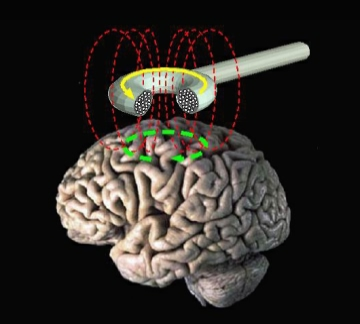
TMS effectively works to restore the homeostasis of these monoamine systems. Using 1.5-2.0 Telsa magnetic signals(similar to those within MRI) reaching about 2-3 inches within the brain(can reach deeper with deep TMS[dTMS]), the signals are converted to electrical currents that trigger cells within the prefrontal cortex to change their firing patterns and release diminished monoamines. These signals can be pulsed at differing frequencies; low pulse signals fire at 1 Hz and high pulse signals fire anywhere from 5-10 Hz. Higher frequencies can still be achieved by utilizing burst patterns. An example of this is four 5 Hz frequencies bursting simultaneously to produce a total frequency of 20 Hz. The signals are a product of the electromagnetic coil pictured to the right. The coil rests upon the patient’s scalp, which is carefully positioned over the left dorsolateral portion of the prefrontal cortex. This is done as the cells impacting the monoamine system are located there and the coil only generates signals to the regions of the brain below it. This minimizes the risk of adverse effects and ensures the greatest deal of safety during treatment as other regions of the brain are not exposed to these signals.
The monoamine system has been the most targeted within treatment methods for depression and for good reason. The effectiveness methods such as transcranial magnetic stimulation have had in treating depression are astounding. Charles DeVine of TMS of Central Florida notes that 70-80% of MDD patients significantly benefitted through TMS treatment with 50% claiming their symptoms were fully reversed one year after treatment. Ongoing research of TMS has made it increasingly popular for depression treatment and one that will continue to benefit more and more lives as time progresses.
Sources:
- https://www.mayoclinic.org/tests-procedures/transcranial-magnetic-stimulation/about/pac-20384625
- https://health.ucsd.edu/care/behavioral-mental-health/depression-treatment/tms/#:~:text=With%20TMS%2C%20the%20magnetic%20pulses,break%20the%20cycle%20of%20depression.
- https://www.ncbi.nlm.nih.gov/pmc/articles/PMC2950973/
- https://pubmed.ncbi.nlm.nih.gov/10920468/
- https://pubmed.ncbi.nlm.nih.gov/17088501/
- https://pubmed.ncbi.nlm.nih.gov/10578452/
- https://my.clevelandclinic.org/health/treatments/17827-transcranial-magnetic-stimulation-tms
- https://www.med.unc.edu/psych/patient-care/interventional-psychiatry/tms/how-tms-works/
- https://www.tmscentralflorida.com/blog/how-successful-is-tms-therapy/#:~:text=Most%20TMS%20providers%20find%20that,or%20anxiety%20symptoms%20after%20treatment.
- https://news.gallup.com/poll/505745/depression-rates-reach-new-highs.aspx
