
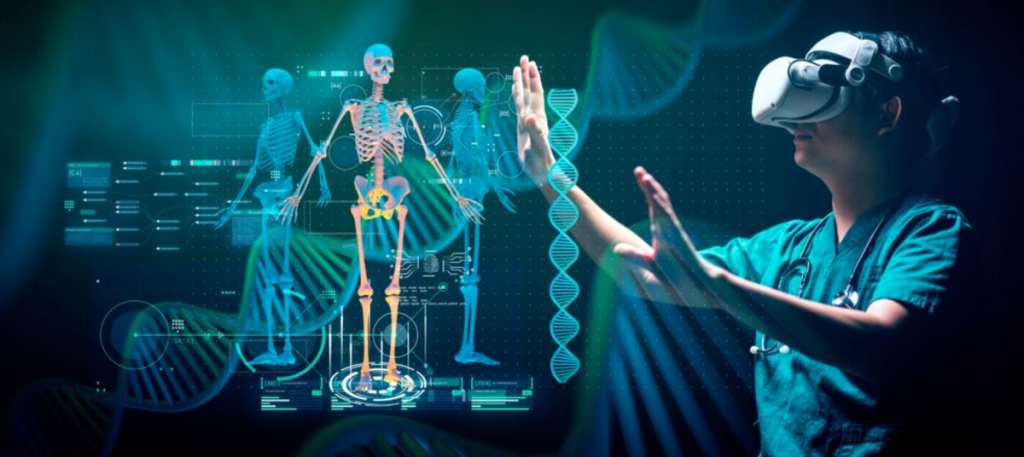
Medical education has undergone a seismic transformation in recent years, driven by advancements in technology. From the early days of anatomical dissections to today’s virtual reality (VR) simulations, the integration of cutting-edge tools is reshaping how future physicians are trained. This evolution not only enhances the learning experience but also addresses challenges such as accessibility, resource limitations, and the need for personalized education. Here, we explore how technology is revolutionizing medical education and the profound impact it is having on the next generation of healthcare providers.
Virtual reality (VR) and augmented reality (AR) are transforming medical education through immersive, interactive experiences. VR platforms allow students to practice surgical techniques in a risk-free environment, enhancing their confidence and dexterity. For example, platforms like Osso VR offer realistic, hands-on training modules that simulate complex surgical procedures, enabling students to refine their skills without the constraints of physical labs (Seymour et al., 2019).
Similarly, AR applications like Microsoft HoloLens overlay digital images onto the physical world, allowing learners to visualize anatomy in three dimensions. This interactive approach fosters deeper understanding compared to traditional two-dimensional textbooks. Studies have shown that AR-enhanced learning improves knowledge retention and spatial reasoning among medical students, making it a powerful tool for mastering human anatomy (Bacca et al., 2014).
Artificial intelligence (AI) is revolutionizing medical education by enabling personalized learning pathways. AI-driven platforms, such as Ada and AMBOSS, analyze students’ performance, identify knowledge gaps, and tailor content to address their specific needs. This adaptive learning ensures that students focus on areas requiring improvement, optimizing their study time and outcomes.
Moreover, AI is enhancing diagnostic training by simulating clinical decision-making processes. For instance, IBM Watson Health uses AI to present case scenarios, encouraging students to develop critical thinking and diagnostic skills. This real-world approach not only sharpens clinical reasoning but also prepares students for the complexities of patient care (Topol, 2019).
The COVID-19 pandemic accelerated the adoption of online learning, making medical education more accessible than ever. Platforms such as Coursera and Khan Academy offer medical courses to a global audience, bridging gaps in geographical and financial barriers. Tele-education, particularly through live-streamed lectures and webinars, ensures continuity of education in remote or underserved areas.
Additionally, digital platforms enable collaborative learning. Virtual study groups and forums allow students worldwide to share resources, discuss cases, and learn from diverse perspectives. These platforms foster a sense of community while democratizing access to high-quality education.
Another game-changing technology in medical education, 3D printing offers cost-effective and customizable models for hands-on training. Anatomical replicas produced through 3D printing provide students with tactile, lifelike experiences that enhance their understanding of complex structures. These models are especially useful in surgical training, where precision is paramount.
Beyond anatomy, 3D printing is transforming prosthetics and implant design. Students can now participate in the creation and testing of patient-specific prosthetics, fostering innovation and interdisciplinary collaboration. This hands-on exposure equips future doctors with practical skills that extend beyond theoretical knowledge (Ventola, 2014).
Despite its benefits, integrating technology into medical education poses challenges. High costs, the need for faculty training, and disparities in access to advanced tools remain significant barriers. Addressing these issues requires investment in infrastructure, partnerships with tech companies, and policies that prioritize equitable access to resources.
Looking ahead, the integration of technologies such as blockchain for credentialing, gamification for engagement, and advanced simulations for emergency training holds immense promise. By embracing these innovations, medical education can continue to evolve, preparing healthcare professionals for the demands of a rapidly changing world.
From VR-powered surgeries to AI-guided learning, technology is revolutionizing medical education in ways that were once the realm of science fiction. These tools are not merely enhancing the learning experience—they are redefining what it means to train as a physician. As technology continues to advance, it will undoubtedly transform medical education into a more accessible, personalized, and effective endeavor, ultimately improving patient care worldwide.
References
- Bacca, J., Baldiris, S., Fabregat, R., Graf, S., & Kinshuk. (2014). Augmented reality trends in education: A systematic review of research and applications. Educational Technology & Society, 17(4), 133–149.
- Seymour, N. E., Gallagher, A. G., Roman, S. A., O’Brien, M. K., Bansal, V. K., Andersen, D. K., & Satava, R. M. (2019). Virtual reality training improves operating room performance: Results of a randomized, double-blinded study. Annals of Surgery, 236(4), 458–463.
- Topol, E. J. (2019). High-performance medicine: The convergence of human and artificial intelligence. Nature Medicine, 25(1), 44–56.
- Ventola, C. L. (2014). Medical applications for 3D printing: Current and projected uses. Pharmacy and Therapeutics, 39(10), 704–711.
