
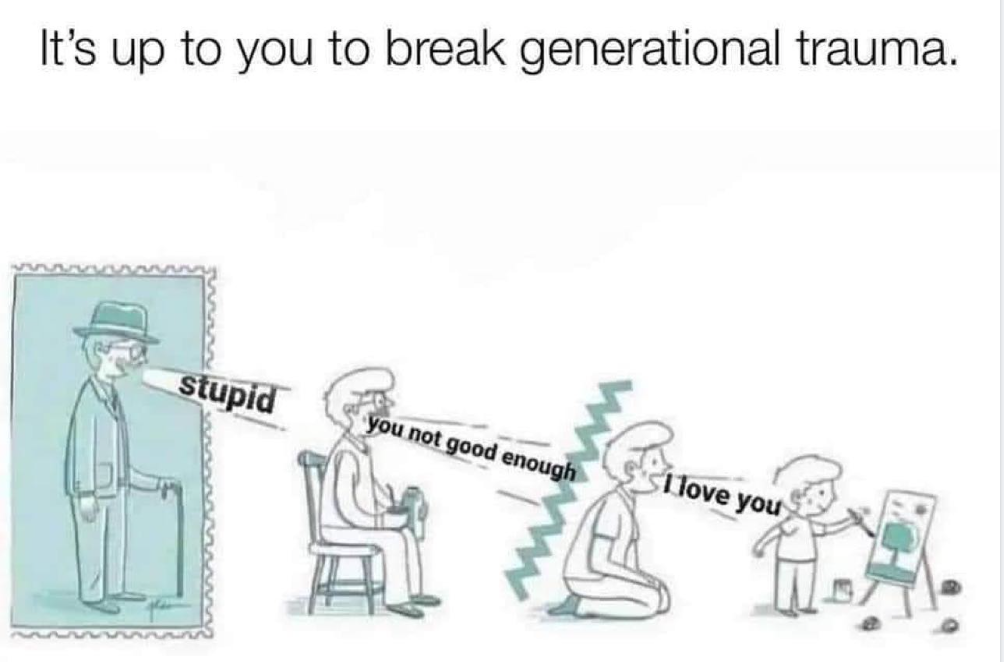
Generational trauma, also known as intergenerational trauma, is an unseen but deeply felt force that shapes family dynamics, belief systems, and emotional well-being. It isn’t tied to one specific event, like a car accident or a natural disaster. Instead, it is passed down through parenting styles, cultural expectations, and unconscious emotional patterns. These unspoken “rules” become part of family tradition, often without anyone realizing their origin.
This kind of trauma runs deep, particularly in Eastern cultures, where perfectionism and family honor are prioritized. Children are often taught to live not just for themselves but for their family name. In contrast, Western cultures encourage individualism, but that too comes with pressure—success and self-worth are often measured by career achievements and independence. Immigrant families must navigate their new identity while balancing both sets of expectations.
For me, this experience is personal. Growing up, the weight of my family’s expectations often felt unbearable. I was expected to succeed, to follow a “respectable” path, and to make the family proud. But as I veered off this course, I was labeled the “black sheep” of the family. For a long time, I resent them. I felt misunderstood, isolated, and suffocated. However, during the stillness of the pandemic, I was forced to confront my emotions. Through reflection and self-healing, I began to see my family not as villains but as people doing the best they could with the knowledge and emotional tools they had.
What I learned is that healing is not about changing the past but accepting it. Healing is hard, but it becomes more manageable when you face it rather than run from it. It takes patience, self-compassion, and the courage to face painful truths. If anyone is ever rushing you to change, it’s not your pace that’s wrong—it’s your environment. Healing is not linear, nor is it something you need to do on anyone else’s timeline. Growth takes time, but it is possible.
The term “historical trauma” was introduced by Dr. Maria Yellow Horse Brave Heart to describe the intergenerational trauma experienced by Indigenous communities as a result of colonization, cultural erasure, and systemic oppression. Today, this concept has expanded to include immigrant families, war survivors, and marginalized communities. Research even shows that trauma can be passed down biologically through epigenetic changes, which alter how genes are expressed without changing the genetic code itself (Yehuda et al., 2016).
This trauma can stem from several sources, including:
- Historical Events: Wars, genocide, colonization, and forced displacement.
- Family-Level Trauma: abuse, poverty, addiction, and high parental expectations.
- Societal Pressure: racial discrimination, marginalization, and systemic inequality.
Without healing, these behaviors are modeled for their children, who internalize the same fears, perfectionism, or emotional suppression. This cycle continues until someone decides to confront it and break the cycle.
Biological evidence shows that generational trauma is not just psychological; it is physical. Trauma can alter gene expression, a concept known as epigenetics. Studies on Holocaust survivors and their descendants revealed that the children of survivors had higher levels of stress hormones and a heightened stress response (Yehuda et al., 2016). These changes were not caused by direct exposure to the trauma but by the legacy of it.
In Eastern cultures, family is seen as a collective unit rather than a collection of individuals. Success isn’t just personal—it belongs to the family as a whole. Children are taught to strive for perfection in academics, careers, and marriage. Anything less than “success” is seen as a collective failure, not just an individual one.
Because of this, love and acceptance can feel conditional. Emotional vulnerability is discouraged, with sayings like “Don’t cry, be strong” reinforcing emotional suppression. The result is that many children grow up with an intense fear of failure, leading to anxious attachment styles, people-pleasing behaviors, and perfectionism.
In Western cultures, independence and self-sufficiency are glorified. While this may seem liberating, it comes with its own pressures. Children are taught that they must “stand on their own two feet” and “make something of themselves.” Success is defined by individual achievement, productivity, and career milestones.
For children who don’t meet these ideals, the result is often shame and self-doubt. Unlike Eastern families where failure is seen as a collective family setback, Western children feel isolated in their perceived “failures.” This can lead to feelings of inadequacy and unworthiness.
Immigrant families experience a unique blend of both Eastern and Western pressures. Children of immigrants often feel torn between honoring their parents’ sacrifices and pursuing personal fulfillment. These families are stuck in a double bind: they are expected to uphold the values of their homeland while simultaneously adapting to Western ideals of independence.
This creates a constant tension known as cultural dissonance. Children of immigrants may feel they don’t fully belong to either world, leading to identity confusion and the constant need to “prove” themselves. Being the outlier in my family, I frequently experienced this dissonance. I wanted to honor my family, but I also craved freedom from their expectations. This inner conflict can become a breeding ground for anxiety, self-doubt, and shame.
One of the most subtle but pervasive signs of generational trauma is the projection of expectations. Parents may seek to “do better” than their own parents, but in striving to avoid their parents’ mistakes, they sometimes create new ones. For instance, a parent who was never allowed to dream big may push their child to achieve academically or professionally. On the surface, this appears positive, but when done excessively, it burdens the child with expectations they never chose for themselves.
In my situation, I frequently felt as though I was living my life according to their expectations rather than my own. I felt the pressure to be “successful,” not for my own fulfillment but to meet their definition of success. This cycle is not uncommon, as many families aim to give their children “a better life” but unknowingly transmit the same fears, anxieties, and insecurities they had as children.
When family members express individuality or diverge from family norms, they are often labeled as the “black sheep.” This label can create feelings of isolation and self-doubt, as the individual is seen as the problem rather than someone simply seeking self-authenticity.
In my case, being labeled as the black sheep hurt deeply. I felt misunderstood and alienated, but with time, I recognized that the label was less about me and more about my family’s discomfort with change. People labeled as “black sheep” are often the ones challenging old cycles and seeking new ways of being. In hindsight, I realized that being the “black sheep” was a sign of growth, not failure.
Psychologists have studied generational trauma through multiple frameworks, with one of the most prominent being attachment theory. John Bowlby’s attachment theory suggests that early childhood attachment styles shape how individuals relate to others throughout their lives. Parents who did not experience secure attachments in their childhood may unknowingly struggle to provide this security for their own children (Main & Solomon, 1986).
Attachment theory shows how early relationships with caregivers shape how we relate to others in adulthood. Parents who are emotionally unavailable or overly critical tend to pass down attachment insecurities. The result is often:
- Secure Attachment
- Characteristics: People with secure attachment feel safe, understood, and supported in relationships. They are comfortable with intimacy, trust others, and have a healthy sense of independence.
- Childhood Origins: Developed when caregivers are consistently responsive, loving, and emotionally available.
- Adult Behavior: They communicate their needs effectively, set boundaries, and have healthy, stable relationships.
- Anxious Attachment (Preoccupied)
- Characteristics: Individuals with anxious attachment fear abandonment, seek constant reassurance, and are highly sensitive to changes in their partner’s behavior.
- Childhood Origins: Often linked to caregivers who are inconsistent or unpredictable in providing affection or support.
- Adult Behavior: They may become clingy, overly dependent, or preoccupied with the relationship, often doubting their worth.
- Avoidant Attachment (Dismissive-Avoidant)
- Characteristics: People with avoidant attachment prioritize independence, avoid emotional intimacy, and may appear distant or emotionally unavailable.
- Childhood Origins: Linked to caregivers who are emotionally distant, dismissive, or unresponsive to the child’s needs.
- Adult Behavior: They may suppress their emotions, avoid vulnerability, and prefer self-reliance, often keeping people at a distance.
- Disorganized Attachment (Fearful-Avoidant)
- Characteristics: These individuals have a mix of anxious and avoidant tendencies. They fear intimacy but also fear being alone, leading to chaotic and unpredictable relationship behaviors.
- Childhood Origins: Often associated with trauma, neglect, or abuse in childhood, where caregivers were a source of fear or harm.
- Adult Behavior: They may seek closeness but then push others away, struggling with emotional regulation and fearing both abandonment and intimacy.
These attachment styles play out in adult relationships, causing people to feel clingy, dismissive, or emotionally unavailable in romantic, personal, professional, or social relationships.
The hypothalamic-pituitary-adrenal (HPA) axis, which regulates stress responses, becomes hyperactive in individuals exposed to early childhood trauma. If a parent has a heightened stress response, they may inadvertently raise their child in an environment where chronic stress becomes the norm. The child’s own HPA axis then becomes dysregulated, making them more vulnerable to anxiety, depression, and hypervigilance (Shonkoff et al., 2012).
Breaking the Cycle: How Healing Begins
Breaking generational trauma is not about “fixing” others; it’s about healing yourself. Growth is a personal journey that requires patience, acceptance, and consistency. Healing is not linear, and it’s not always pretty. The truth is, no one can be forced to heal before they are ready. It requires facing uncomfortable truths—something that’s hard to do when triggers are present.
Here’s how healing begins:
1. Self-Awareness and Acceptance
The first step to healing is awareness. You cannot heal from something you don’t recognize. Acknowledge the patterns that no longer serve you. Ask yourself:
- What family belief has kept me stuck?
- Whose voice is in my head telling me I’m not enough?
Becoming aware of these patterns doesn’t mean blaming your parents. It means understanding that they were only passing down what they knew.
2. Self-Compassion and Patience
Healing is not a race. If you’re being rushed to “get over it,” consider changing your environment, not yourself. Healing happens in safe, supportive spaces. There is no deadline to heal. It happens one small step at a time. Self-compassion is about giving yourself grace when you stumble, and patience is about recognizing that growth is slow.
3. Therapy/Self Therapy and Professional Support
Therapy is essential for untangling the emotional threads of generational trauma. It provides the space to recognize patterns, reframe beliefs, and build better coping strategies. Self-healing through journaling, reflection, and mindfulness also plays a key role.
However, nowadays, with social media providing multiple tools for free on YouTube, TikTok, Instagram, etc., we can easily start to research and heal ourselves at our own comfort. But it is only wise to do this if you are ready for the upcoming triggers and challenges; otherwise, I would suggest doing therapy or coaching for the first few sessions and transitioning into doing your own healing without the presence or reliance of another.
4. Boundaries and Environment
There is no deadline for healing. If someone in your life is pressuring you to “change faster,” it’s a sign that you may need to change your environment. True growth happens when you feel safe, not when you feel rushed. As I embraced this, I became more patient with myself. Growth is slow, but it is real.
Healing begins when you accept that your past cannot be changed—but your future can. It starts with patience, self-compassion, and the courage to look at your own wounds. I used to think healing was about “fixing” my family. But I’ve learned that it’s not my job to “fix” anyone. My only job is to heal myself.
For years, I resented my family for labeling me the “black sheep.” But during the pandemic, I began to reflect on where their behaviors came from. I realized they weren’t “bad parents”—they were just people doing their best with what they had. Sometimes, in trying to do the opposite of our parents, we end up repeating them.
Acceptance became my path to freedom. I stopped trying to “fix” my family and started focusing on myself. I worked through my triggers, learned to set boundaries, and stopped rushing my growth. And slowly, I saw something beautiful: my family changed too. We communicate more openly, listen without judgment, and have a deeper understanding of each other.
Breaking the cycle of generational trauma is not easy, but it is possible. It requires self-awareness, patience, and a willingness to confront uncomfortable truths. If someone is pressuring you to “change,” know that it’s not your pace that needs adjusting—it may be your environment.
Too many people bear the burden of generational trauma. It can be hard to see it while you’re in it, but with awareness, it becomes clear that it is not your fault. It is a product of history, culture, and family circumstances. No path to healing is easy, but it becomes easier when you stop running from it.
The truth is, perfection is a myth. Eastern cultures often prioritize it, while Western cultures promote individuality—but neither is perfect. Immigrant families find themselves at the intersection of two worlds, grappling with the ideals of the East and the potential of the West. But we do not have to be bound by these ideals.
For me, the journey from resentment to acceptance taught me that growth is slow but not impossible. With patience and consistency, I saw change in myself, and in time, I noticed change in my family too. The “black sheep” of the family aren’t the outcasts—they are the cyclebreakers. They are the ones brave enough to face the pain that no one else will. They are the ones who, through self-healing, liberate future generations from the burdens of the past.
If you are the “black sheep,” wear that title with pride. You are not the problem. You are the change.
References
- Yehuda, R., et al. (2016). Holocaust Exposure Induced Intergenerational Effects on FKBP5 Methylation. Biological Psychiatry.
- Main, M., & Solomon, J. (1986). Discovery of a New, Insecure-Disorganized/Disoriented Attachment Pattern. Affective Development in Infancy, 95, 121-160.
- Shonkoff, J. P., et al. (2012). The Lifelong Effects of Early Childhood Adversity and Toxic Stress. Pediatrics, 129(1), 232–246.
