
Seeing Beyond Limits: How Stereo Vision Technology Transforms Life for the Visually Impaired
The blind population often struggles to navigate our complex and intricate world. While the traditional walking stick can help patients avoid obstacles in their immediate vicinity, they are ineffective at helping the visually impaired population visualize said objects and more broadly, the world around them. Since the turn of the 21st century, science has seen consistent engineering advancements to help the visually impaired collect information about their surroundings, including the size, position, and distance of potential obstacles. For example, engineers implemented ultrasonic, infrared, and ultraviolet sensors for the aforementioned walking sticks; however, each advancement came with pitfalls, ultimately rendering them unfeasible as a long term solution to obstacle recognition in the blind. No such advancement successfully allowed the patient to visualize the size, position, and distance of objects until the birth of stereo vision technology.
The Intelligent System Research Team of Prince of Songkla University, Thailand have developed stereo vision technology that utilizes intensity-based stereo matching(ISM) and image processing techniques to modify the traditional walking stick. Their design for their stereo vision technology includes a hat atop the patient’s head with a camera on each side of the head. ISM incorporates Pixel to Pixel Stereo(P2P), which involves pixel analysis of the two images taken by each camera, measuring the disparity between the images.
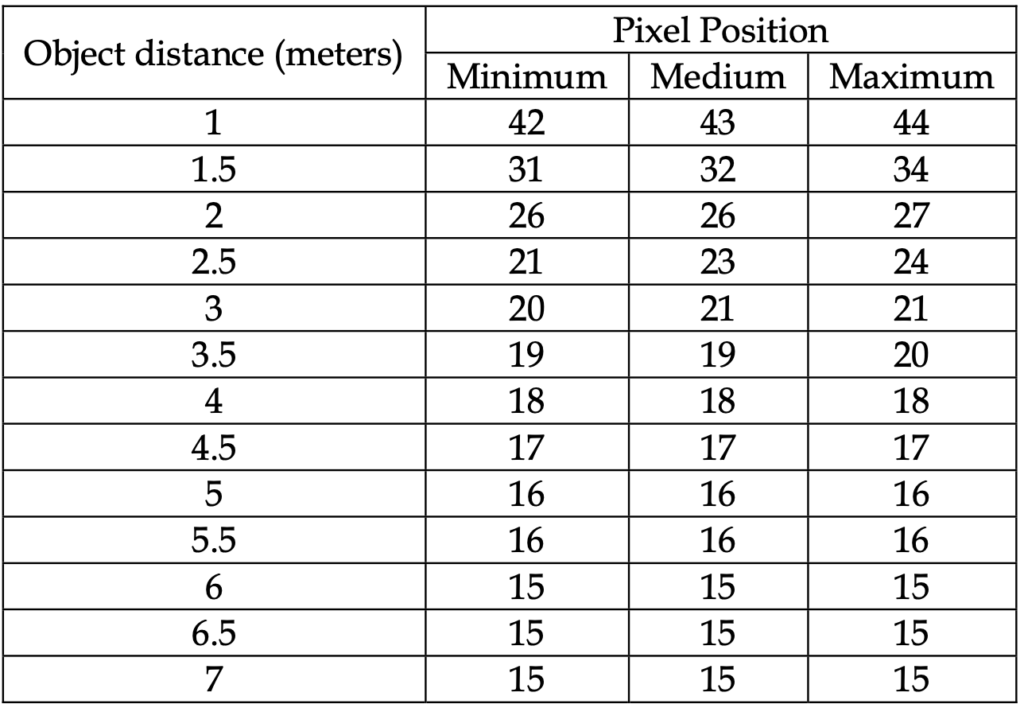
As shown below, the left and the right images are of the same surroundings, however, the right picture is offset a certain distance because of the gap between the cameras. To oversimplify, measuring the pixel differences between two corresponding points on the images gives this disparity. In closer objects, this disparity value will be higher and in farther objects, this value will be lower. To visualize this phenomenon, close your right eye and then reopen it while quickly closing your left eye. You will notice a noticeable shift in closer objects and a less noticeable shift in farther objects. Below is a table characterizing the pixel disparity for objects at different distances from the camera that the research group found. The ultimate product of P2P is a V-disparity image obtained from the disparity image, the former of which summarizes the disparity values within each scan line.

Left Image
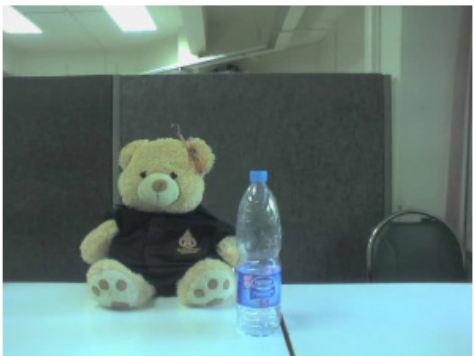
Right Image
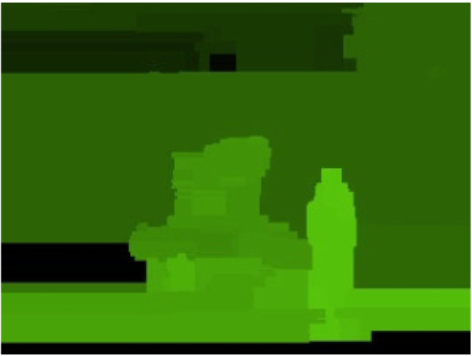
Disparity Image
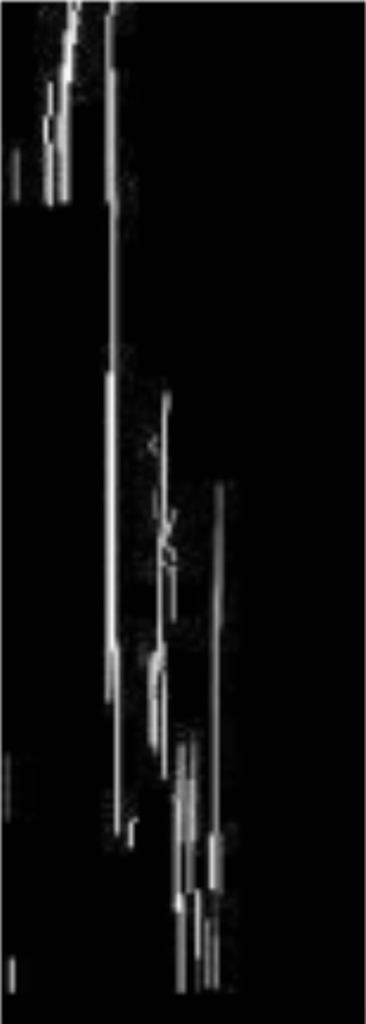
Each vertical line’s length within the V-disparity image(pictured right) represents the object’s height within a disparity image. The line’s distance from the left edge of the image represents the object’s distance from the stereo cameras. These distances, along with references to prior measurements taken, can help determine the size and distances of objects.
The device then utilizes OpenCV functions and cvHoughLine functions to obtain straight lines from the above V-disparity image. The below equation gives us the object’s distance, d, from the camera by plugging in the object’s depth, x, which the aforementioned functions return. The device can warn patients of objects of distances up to 9 additional meters past the range of the walking stick(approximately 1 meter of range). The device effectively serves as a supplement to the walking stick, warning the patient of objects at further distances.

Plugs x value(object depth) into this equation to obtain d(distance from the camera)
Another important step in engineering a better world for the visually impaired population involves reducing processing times for stereo-vision devices. The research group found that increasing the number of processes within the 2-core PCs from 1 to 2 reduces computing time by a factor of 2. However, any subsequent processes added will not impact processing time. This is only the case with 2-core PCs, however. Changing the PC to one of 8-core reduces processing by over 88% when increasing the number of processes from 1 to 2 in two picture of maximum disparity of 100. Adding subsequent processes reduces the computing time by a factor of how many are added with respect to the already existing two processes. This means increasing the process count to 8 will reduce the computing time by a factor of 4 compared to what it was with 2 processes. Additionally, they found that higher pixel resolution and higher maximum disparity values can be attributed to higher processing times.
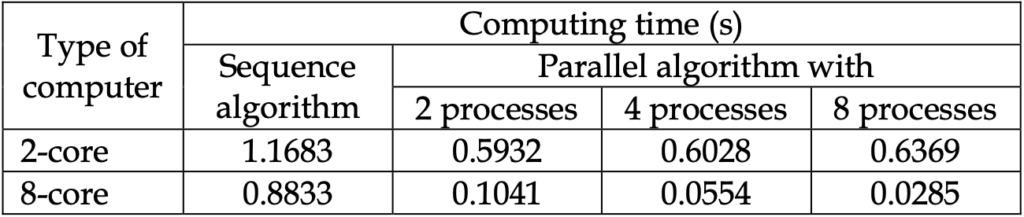
Computing times with varying # of processes in 2-core and 8-core computers
This further research on stereo vision technology has rendered them an effective supplement to the traditional walking stick due to their added features of object detection up to 10 feet, distance and size calculation, and position approximation. This advancement in rehabilitation can help your visually impaired loved one more effectively visualize our world. Looking forward, when prices allow for better computing devices and further research and testing have been conducted to gauge performance, stereo-vision will likely become commercially available for the betterment of the visually impaired population.
Source:
Kheng, T. Y., Suvonvorn, N., Limna, T., & Tandayya, P. (2009). Stereo Vision Utilizing Parallel Computing for the Visually Impaired. In Rehabilitation Engineering (pp. 63–78). essay, Intech.
