Imagine waking up one morning and suddenly everything changes. You may have problems doing your daily tasks, lifting your arm, or even with your speech. This is the reality of many people who suffer from strokes every year.
Understanding Stroke: What It Is and Why It Matters
A stroke is a serious medical condition that occurs when a portion of the brain is deprived of sufficient blood flow. This usually results from a blocked artery or bleeding within the brain. When the brain doesn’t receive a constant supply of blood, the affected brain cells begin to die due to a lack of oxygen. A stroke can affect anyone, from children to adults, but certain individuals are at a higher risk than others. Strokes are more prevalent in older adults, with approximately two-thirds occurring in people over the age of 65. Various regions of the brain govern different functions, so stroke symptoms vary depending on the area impacted. For instance, if a stroke affects Broca’s area, which controls the muscles used for speech in the face and mouth, individuals may slur their words or struggle to speak. In most cases, it also affects upper limb movements and may cause paralysis of one side of the body.
Stroke Rehabilitation:
Stroke rehabilitation, or “rehab,” is designed to help you regain as much independence and quality of life as possible. It supports your physical, emotional, social, and spiritual recovery after a stroke, aiming to restore your optimal health. Stroke rehabilitation therapy is like learning to do things all over again.
A key aspect of rehabilitation therapy is ensuring that the patient performs exercises accurately, especially since stroke often results in upper limb movement impairments. Stroke survivors may adapt to new limitations by altering their movement patterns, using stronger or unaffected joints and muscles. However, if these compensatory movements are used during rehabilitation exercises, they can lead to less effective outcomes.
Digital Health Tools for Stroke Rehabilitation:
The Toronto Rehab Stroke Pose (TRSP) dataset represents a recent advancement in this field. The scientists presented a dataset which was created to aid in the development of a system that can recognize compensatory movements automatically. This system would be useful in assisting stroke victims in maintaining appropriate posture during rehabilitation. Clinically relevant motions from robotic rehabilitation exercises are included in the dataset, which was collected with a Microsoft Kinect sensor, like those found in video game consoles. This study featured two groups of participants: 10 healthy individuals and 9 stroke survivors, who performed a series of seated movements with an upper-limb rehabilitation robot. To replicate typical compensatory actions following a stroke, healthy participants also executed additional sets of pre-planned movements. Common clinical assessment scores are also included in the dataset, and two experts annotated the compensatory movements of both stroke and healthy participants.
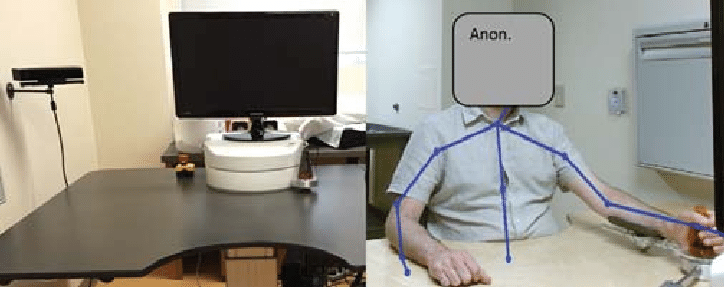
(Left) the haptic robot and Kinect sensor set up. (Right) a participant operating the haptic robot.
How This Technology Benefits Stroke Patients
Following a stroke, diminished upper-limb movement control is common and can have a significant impact on everyday activities. To regain motor function, chronic stroke survivors may benefit from continued, intense upper limb rehabilitation. Robotic stroke rehabilitation offers the potential to enhance treatment and improve stroke outcomes, making rehabilitation more effective and efficient. The automated tool should detect incorrect postures or compensatory upper-limb movements. The system could then provide feedback, such as auditory or visual cues, to help stroke survivors adjust and correct their body positioning. In this way, the patients can be assured they are on the right track.
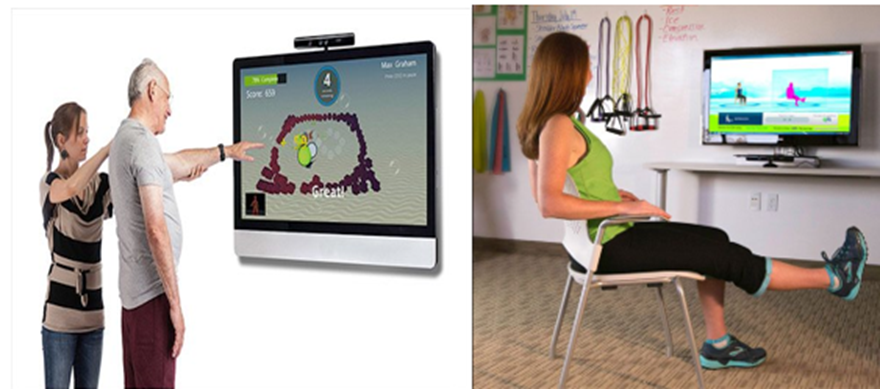
Patients performing rehabilitation exercises using Microsoft Kinect Device
A Brighter Future for Stroke Survivors
There is a lot of hope for digital health to transform stroke care, with innovations aimed at enhancing patient support, personalized rehabilitation, and diagnosis. Virtual reality and gamification in digital platforms are expected to increase the engagement of rehabilitation, increase adherence, and possibly speed up recovery. To prevent inequalities in care, the successful integration of these technologies will need to address ethical and legal issues while guaranteeing data security, privacy, and fair access.
References:
Dolatabadi, E., Zhi, Y. X., Ye, B., Coahran, M., Lupinacci, G., Mihailidis, A., Wang, R., & Taati, B. (2017). The toronto rehab stroke pose dataset to detect compensation during stroke rehabilitation therapy. Pervasive Health, 17. https://doi.org/10.1145/3154862.3154925
Rehabilitation for stroke. (2023). Johns Hopkins Medicine. https://www.hopkinsmedicine.org/health/conditions-and-diseases/stroke/rehabilitation-for-stroke
Silva, G. S., & De Andrade, J. B. C. (2024). Digital health in stroke: A narrative review. Arquivos De Neuro-Psiquiatria, 82(08), 001–010. https://doi.org/10.1055/s-0044-1789201
Stroke Overview. (2024). National Institute of Neurological Disorders and Stroke. https://www.ninds.nih.gov/health-information/stroke/stroke-overview
Stroke. (2024). Cleveland Clinic. https://my.clevelandclinic.org/health/diseases/5601-stroke
